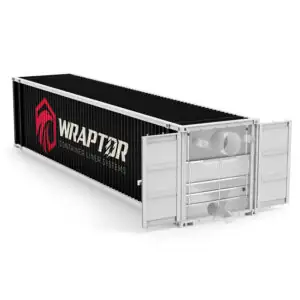





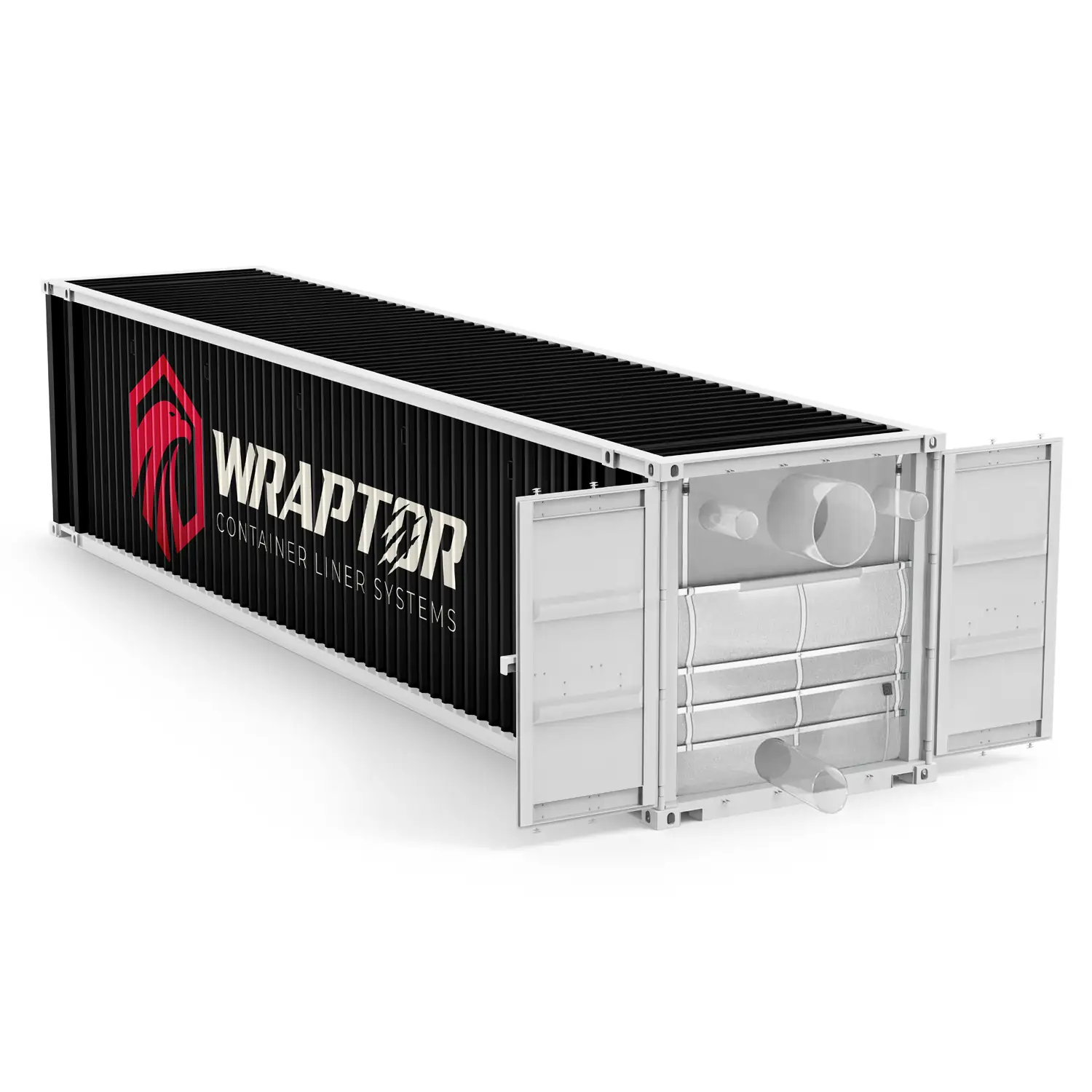
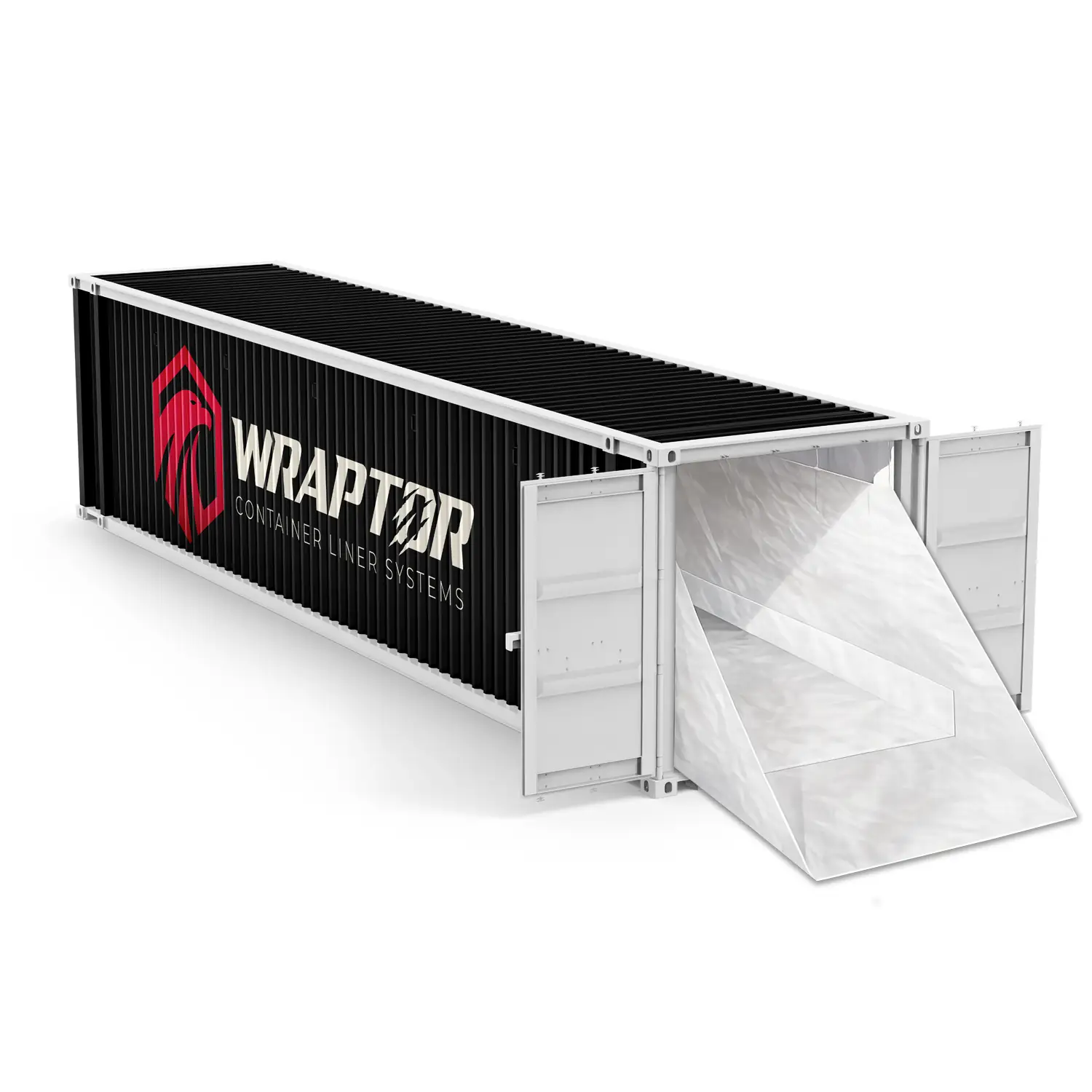
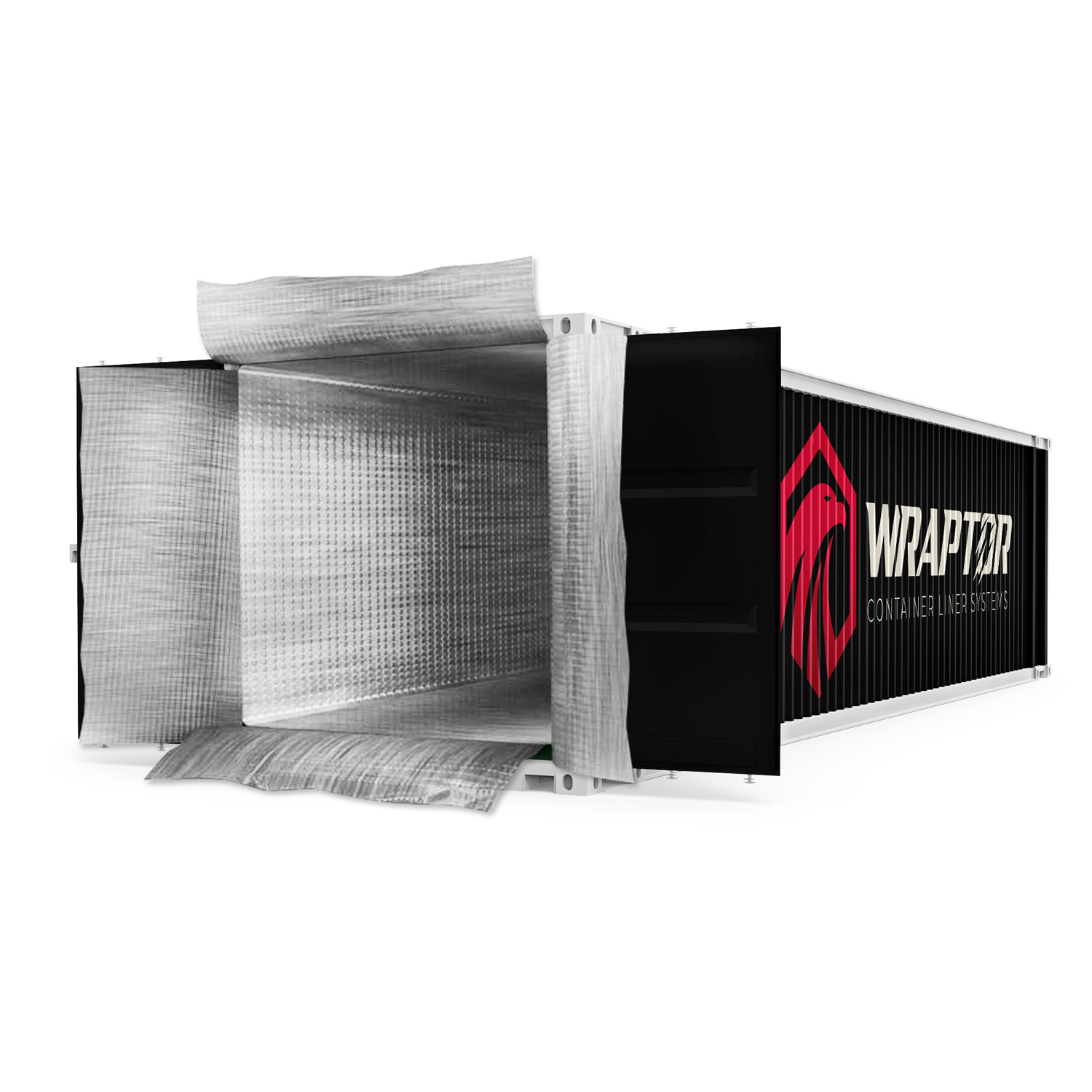
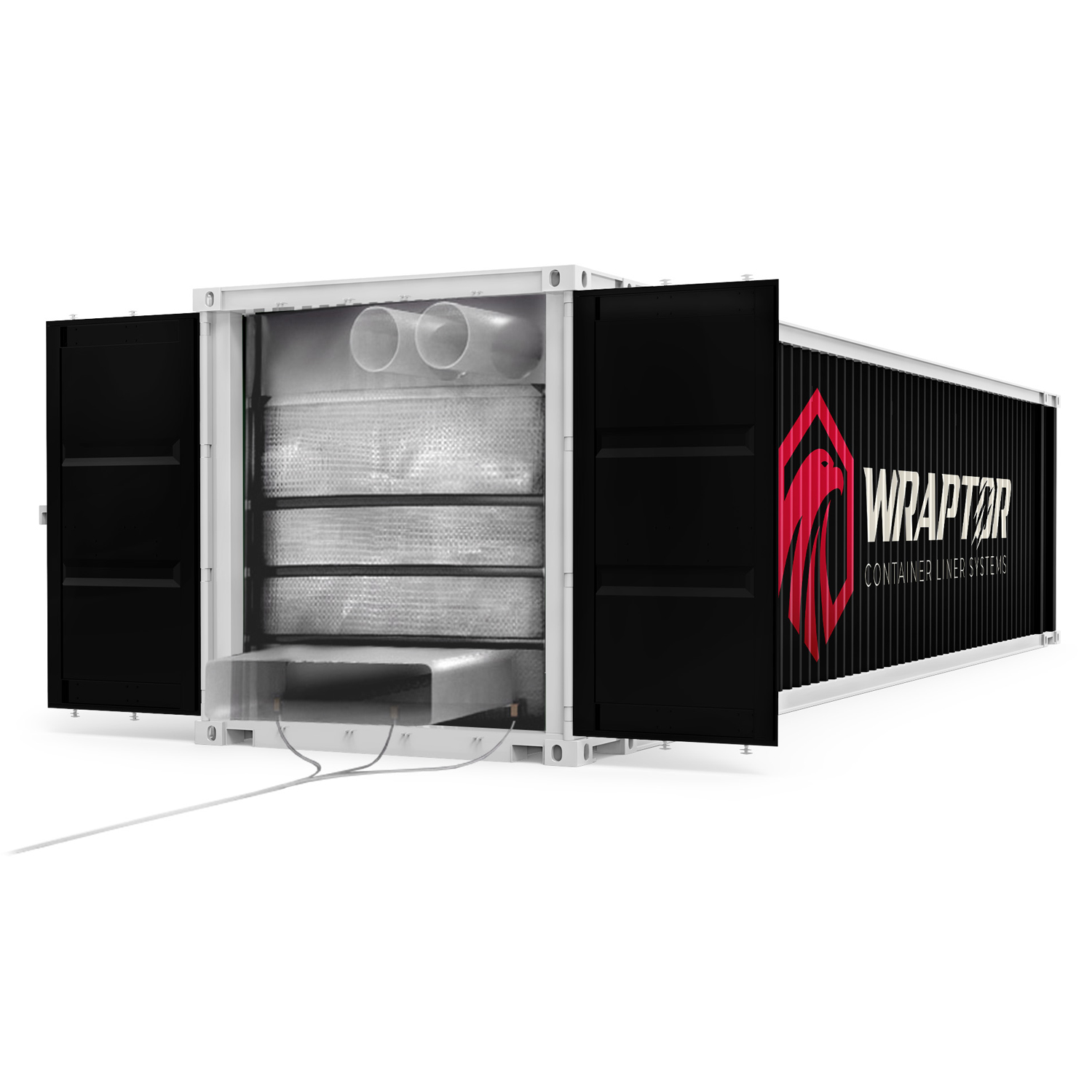
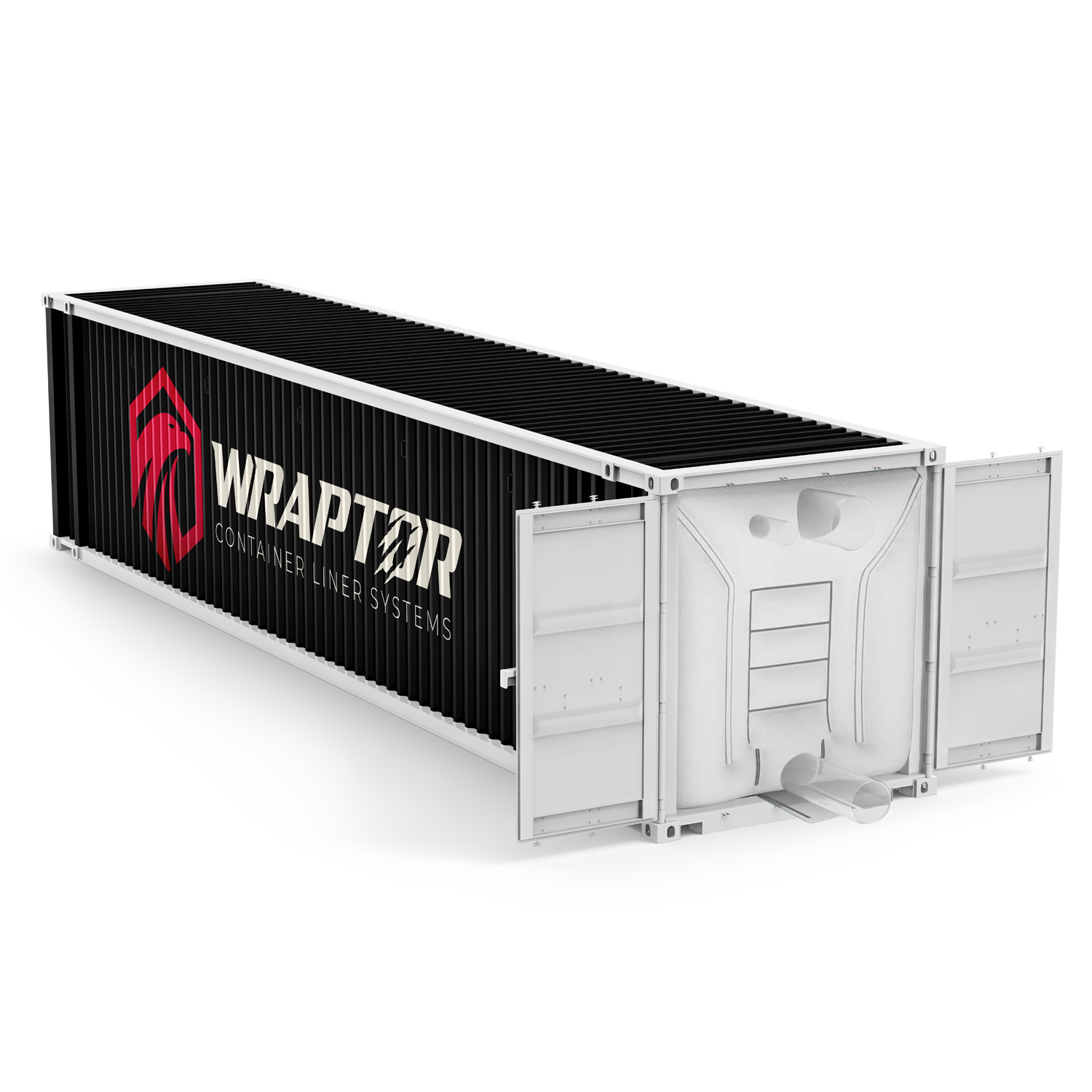
An ISO container liner is a single-use liner sized to the internal dimensions of a standard 20ft or 40ft ISO 668 shipping container, turning the container itself into a sealed bulk transport vessel. At Palmetto Industries, our Wraptor® ISO container liners are engineered to ISO 668 and ISO 1496-1 standards, so a single liner design fits any compliant container in the global fleet — across every major port and every shipping line.
We've manufactured ISO container liners since 1994 from facilities holding BRC, AIB, and FSSC 22000 certifications, with vertically integrated production in Pondicherry, India, under our direct ownership since 2006. That end-to-end control from raw resin through finished liner is what makes Wraptor® a standard spec for shippers whose ISO container loads can't fail.
Tell us about your shipment, and our team will recommend the right liner — contact us to get started.
Built for ISO 668 container dimensions
ISO container liners are engineered around the dimensional standards set by ISO 668, the international specification that defines freight container classifications, ratings, and minimum dimensions. Every standard 20ft (Type 1C/1CC) and 40ft (Type 1A/1AA) container in the global fleet conforms to these external dimensions.
The standard allows a tolerance of just +0 / -0.236 inches on a 20ft container and +0 / -0.394 inches on a 40ft container. That tight tolerance is what makes a single Wraptor® liner design work across millions of containers in circulation worldwide — and it's why we engineer every ISO liner in our wider range of bulk container liners to ISO 668 and ISO 1496-1 standards rather than a single shipping line's spec. Our team builds every liner to maximize the standardized payload without leaving dead space at the doors or top.
ISO container liner types from Palmetto
Wraptor® ISO container liners come in six configurations, each engineered for a specific dry bulk loading profile, product behavior, or container access setup. The right choice depends on three things: how your product flows, what equipment you're loading with, and which container doors or hatches you have access to. Our team will walk you through these variables and recommend the right configuration for your operation.
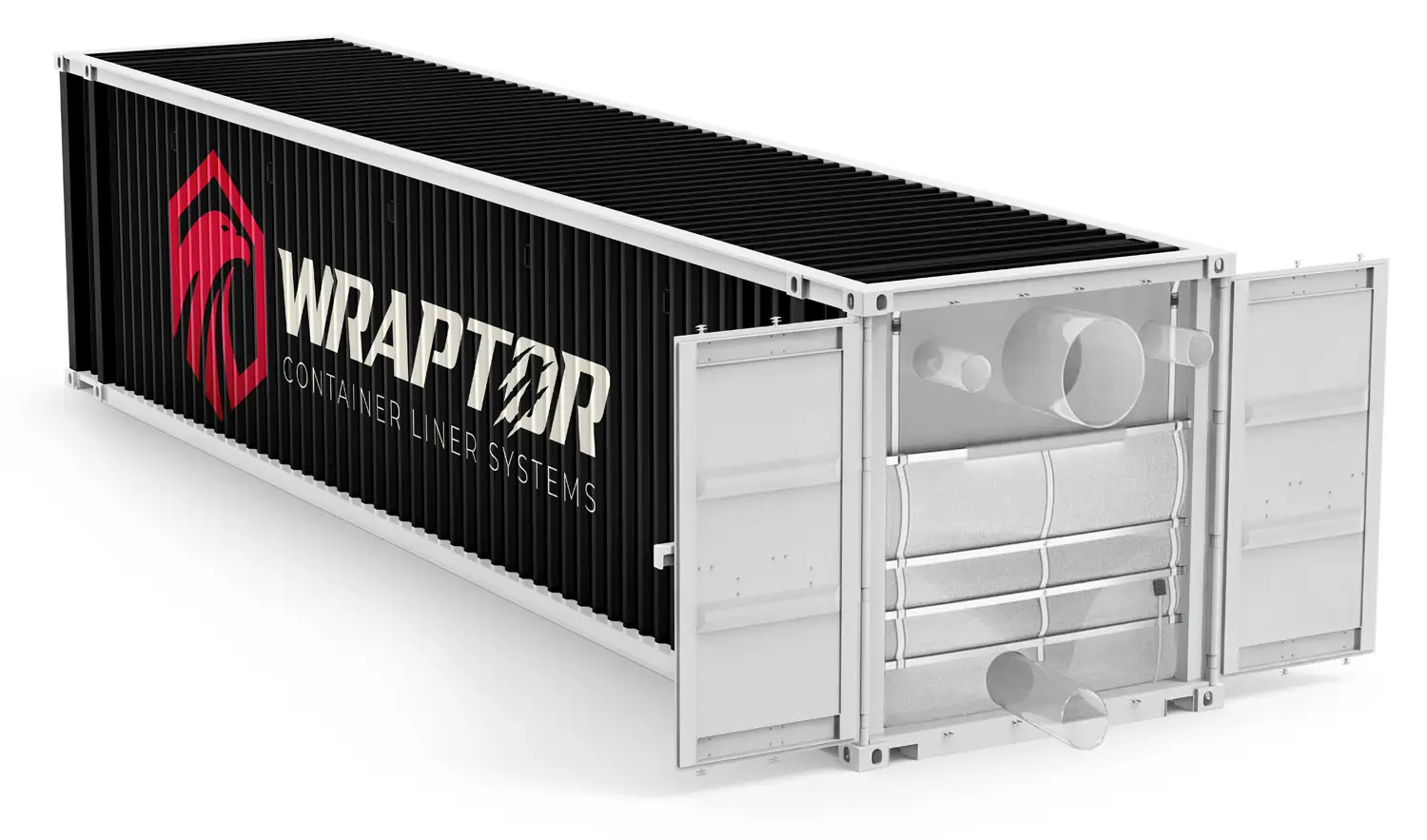
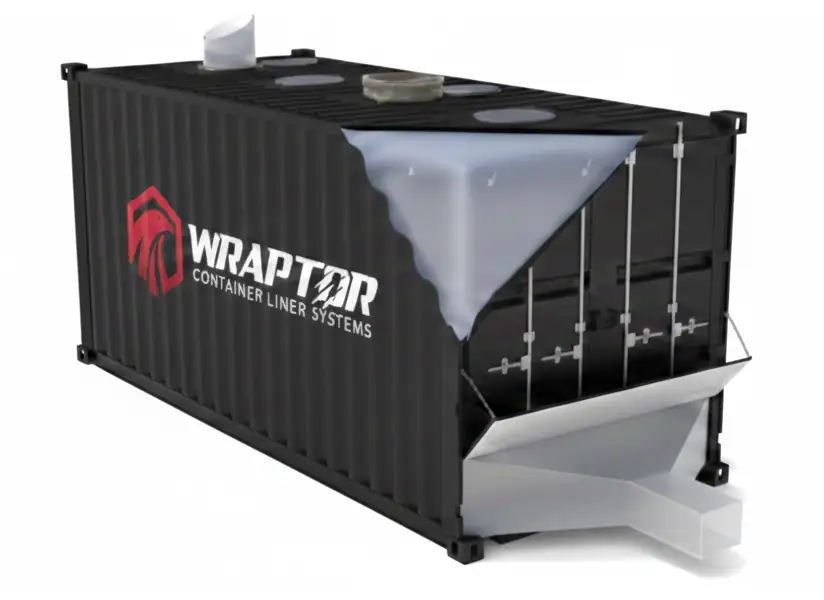
Front spout/back fill container liners
Front spout liners are the workhorse of dry bulk ISO container shipping, installed inside any 20ft, 30ft, 40ft, or 53ft ISO container and loaded from the door end via belt thrower, pneumatic pump, conveyor, or gravity feed. They handle the widest range of free-flowing dry bulk products of any Wraptor® liner.
- Product range: Carry granular, powder, pellet, or flaked products in both food-grade and industrial-grade applications — from corn and rice to PE pellets and mineral powders.
- Film construction: Available in food-grade high-tensile co-extruded LLDPE film with excellent moisture barrier (WVTR) properties, plus antistatic/dissipative variants for products sensitive to static buildup.
- Discharge flexibility: Designed for loading or discharge with one or both ISO container doors open, giving operations crews flexibility depending on the receiving facility.
- Payload efficiency: Maximize the full internal volume of the ISO container so the unit delivers close to its full rated capacity rather than losing space to dead zones.
- Sustainability: All component parts are 100% recyclable, supporting the environmental commitments many of our food and chemical customers report to their own buyers.
Wet hide/open top container liners
Wet hide containment liners are built for any ISO container, trailer, or railcar moving animal hides, contaminated soil, or wet products prone to seepage. The construction prioritizes leakproof performance over the lightweight flexibility of standard dry bulk liners.
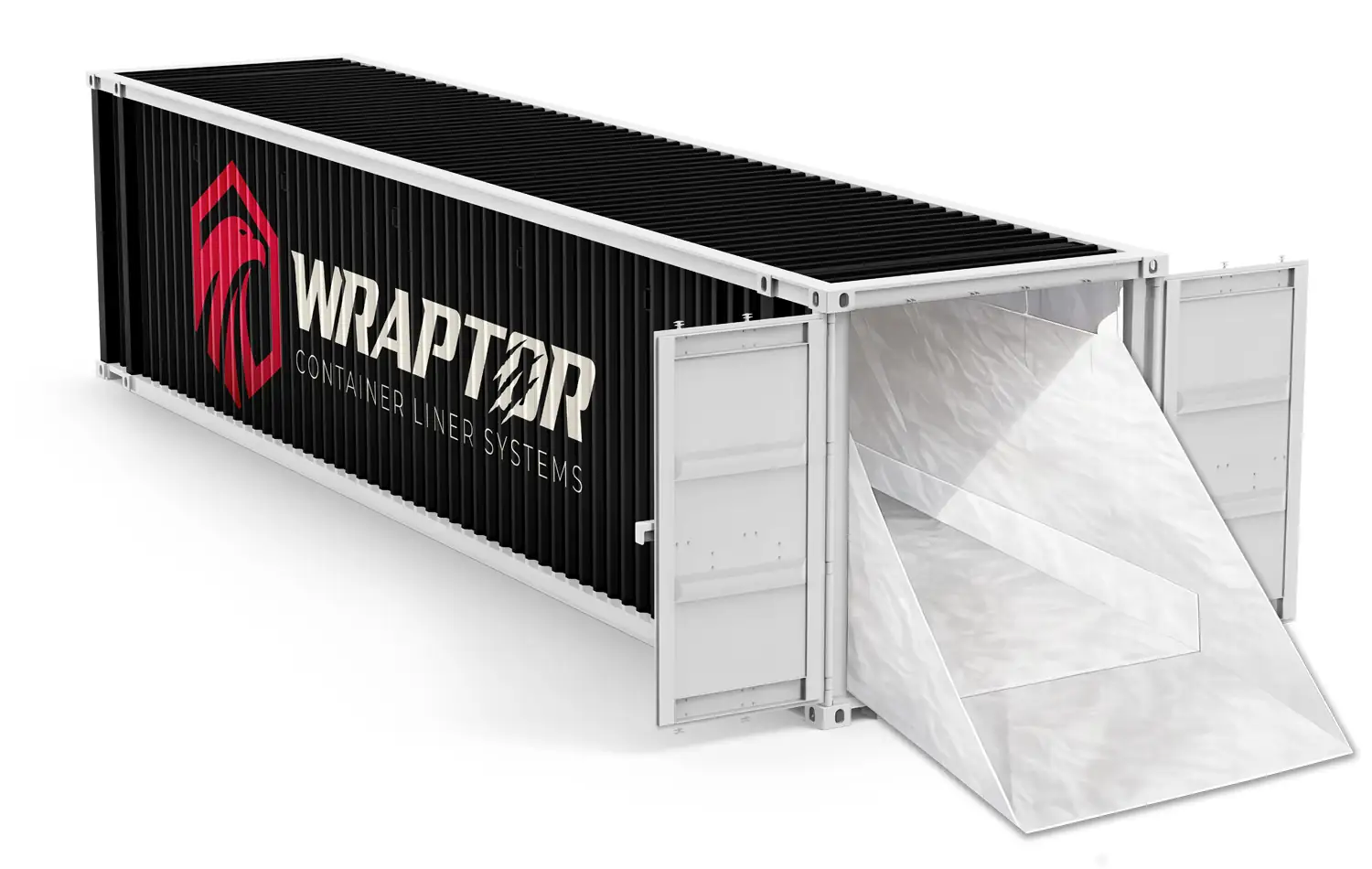
- Welded seams: Continuous welded construction provides leakproof containment for products that would breach a stitched seam.
- Heavy-gauge fabric: Available in woven HDPE up to 50mil thickness, offering puncture and tear resistance that standard PE film cannot match.
- Forklift-ready floor: A felt floor option lets operators drive forklifts directly into the ISO container during loading and unloading without tearing the liner — significantly reducing damage claims.
- Strength tiers: Three different strength options let you match the liner to the product weight and handling intensity rather than overpaying for capacity you don't need.
Top fill container liners
Top fill liners are installed inside 20ft, 30ft, 40ft, or 53ft ISO containers and loaded from the top through hatches via gravity. They're the right choice when your loading facility has overhead silos, hoppers, or gantry-mounted spouts — common at port-side terminal facilities and grain elevators.
- Loading method: Gravity fill from the top via hatch openings, which means no pumping equipment is required at the loading site.
- Product compatibility: Handle the same broad range of free-flowing granular, powder, pellet, and flaked products as front-fill liners — both food-grade and industrial-grade.
- Discharge configuration: Designed for discharge through a letterbox hatch or hatches at the base of the container end, giving receiving facilities controlled gravity discharge.
- Operational fit: Best matched to facilities that already have top-loading infrastructure, since retrofitting a port for top-fill operations is rarely cost-justified.
Thermal container liners
Thermal liners are engineered for ISO container shipments where the product would deteriorate from odor, light, oxygen, or moisture ingress during long ocean voyages. Construction uses aluminum barrier foil laminate sandwiched between co-extruded PE/PET layers.
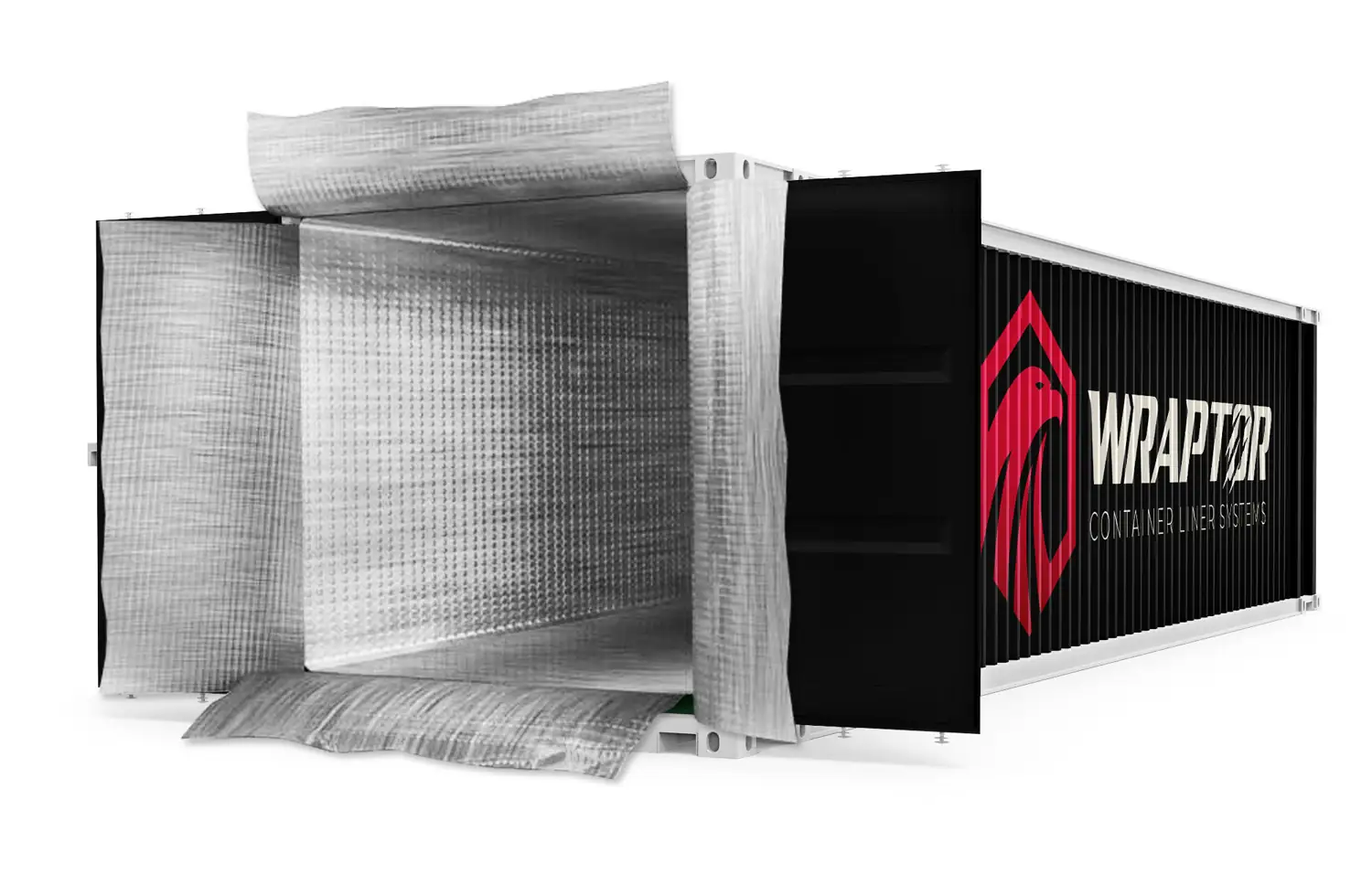
- Barrier performance: Up to 80 times more effective than 125mu polyethylene film at preventing moisture damage during transoceanic transit — a margin that matters when a container sits on a vessel for 30+ days.
- Sealing capability: Foil liners can be completely sealed for airtight containment, protecting flavor-sensitive food products and oxygen-sensitive chemicals.
- Installation options: Open-ended, top loading, or end-filling via loading spouts — fits any ISO container access configuration your facility uses.
- Bulkhead construction: Woven polypropylene bulkheads on end-filling liners provide structural integrity at the door end where pressure during transit is highest.
Barless container liners
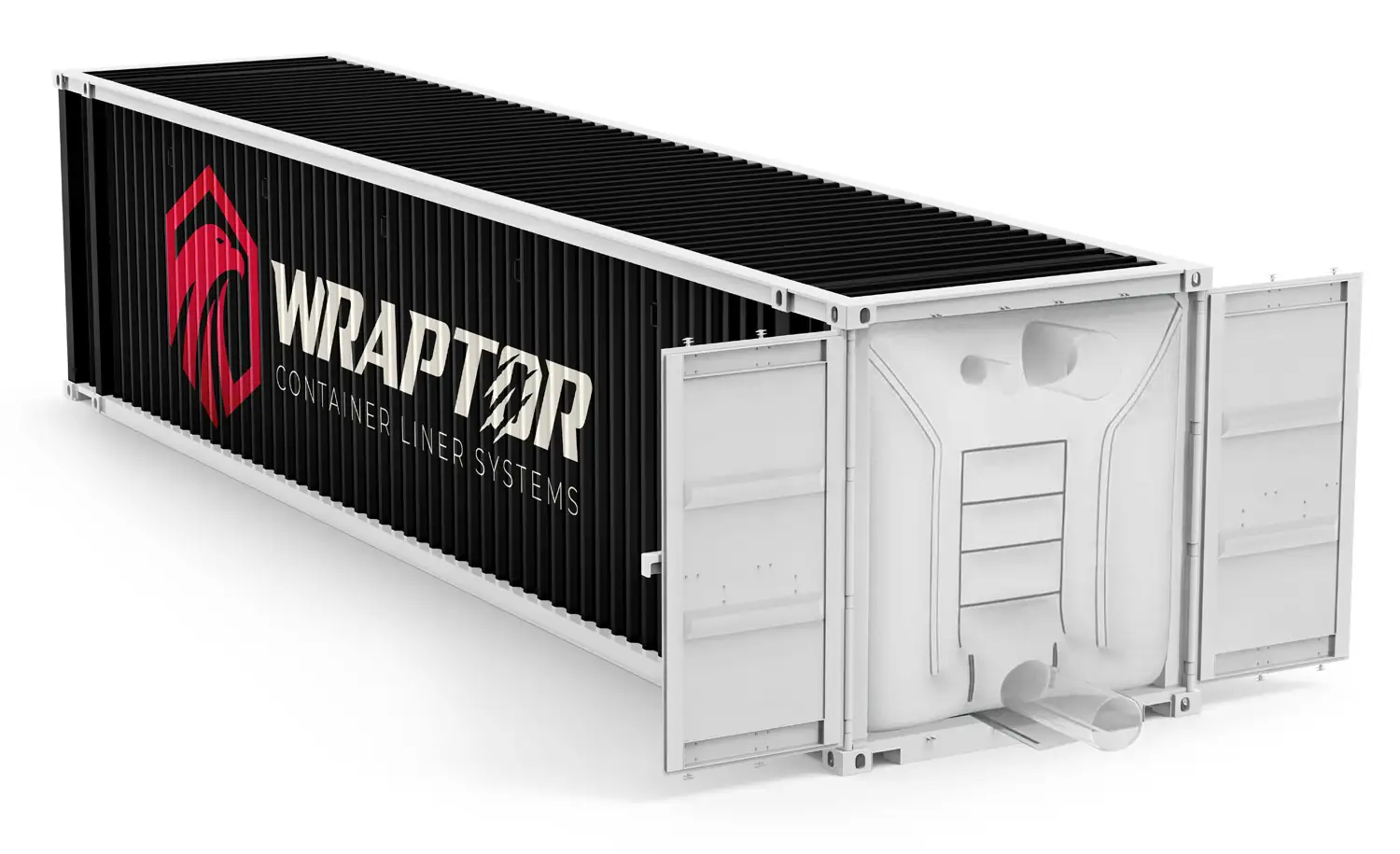
Barless ISO container liners eliminate the horizontal restraint bars that traditional liners require at the door end. The liner itself is constructed from woven HDPE or woven polypropylene fabric strong enough to hold back the product without external bracing.
- Faster installation: No bar installation means crews can prep an ISO container in a fraction of the time a barred liner takes — meaningful when you're turning multiple containers per shift.
- Industrial-grade products: Built for free-flowing granular, pellet, and flaked industrial-grade products such as plastic resins, mineral concentrates, and animal feed ingredients.
- Fabric strength: Woven HDPE and woven PP construction provides high tensile strength, with antistatic and conductive fabric grades available for static-sensitive products.
- Cost efficiency: Eliminates the per-container hardware cost of restraint bars while maintaining the load integrity needed for industrial dry bulk shipments.
Fluidizing container liners
Fluidizing liners are engineered for products that compact during transit and refuse to flow freely on discharge — fly ash, calcium carbonate, flour, talc, and similar hard-to-handle powders. Compressed air channels in the liner floor break the compaction so the product flows out of the ISO container cleanly.
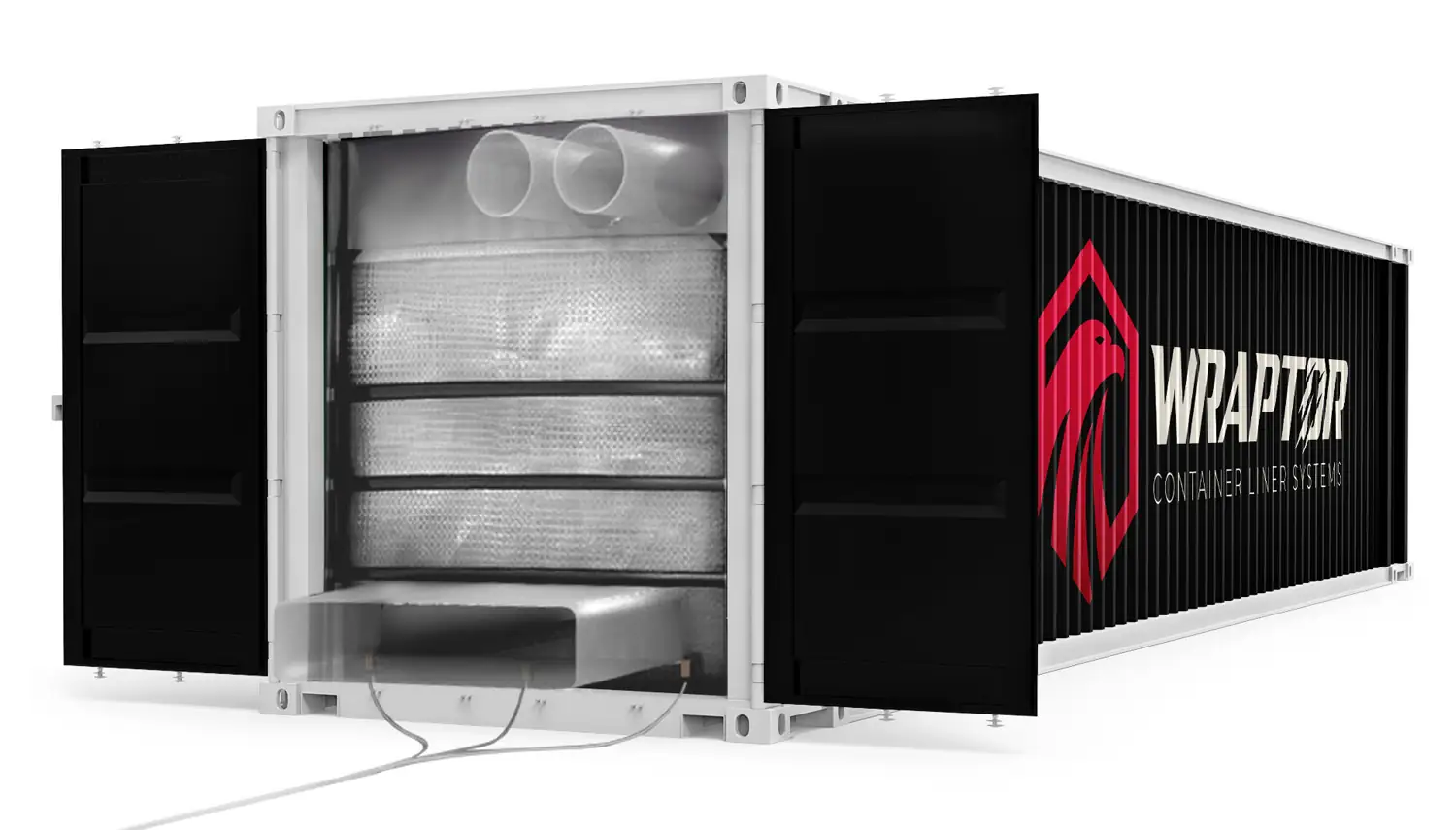
- Sectional control: Full or partial fluidization is controllable section by section at both ends of the container, giving operators precise discharge management.
- Product range: Designed specifically for hard-to-flow and compactable products — the kinds of fine powders that bridge, rathole, or set up solid during ocean transit.
- Premium film: Virgin food-grade high-tensile co-extruded LLDPE film with excellent moisture (WVTR) properties and a slip-special surface to aid product release.
- Discharge efficiency: Quickly re-flows heavily compacted product to allow easy, controlled discharge — eliminating the manual labor and product loss that comes with dislodging compacted material.
ISO container dimensions and Wraptor® liner capacity
Choosing the right ISO container size and liner combination starts with knowing your effective payload. The table below shows the standard internal capacity of ISO 668 containers and approximate Wraptor® liner fill volumes, which factor in headspace for loading and the natural shape a liner takes when filled.
| ISO container type | Internal volume | Approximate liner fill volume | Typical dry bulk payload (free-flowing) |
|---|---|---|---|
| 20ft ISO (1C/1CC) | 33.2 m³ / 1,172 ft³ | ~28–30 m³ | 20–24 metric tons |
| 40ft ISO (1A/1AA) | 67.7 m³ / 2,390 ft³ | ~58–62 m³ | 22–26 metric tons |
| 40ft ISO High Cube (1AAA) | 76.4 m³ / 2,700 ft³ | ~65–70 m³ | 22–26 metric tons |
| 53ft (non-ISO domestic) | ~108 m³ / 3,830 ft³ | ~92–96 m³ | 24–28 metric tons |
Payload weights depend on product density and road/rail weight limits in the origin and destination countries — not just the volume the container can hold. Most international dry bulk shipments hit the weight limit before the volume limit, and our team will help you specify a liner that maximizes tonnage within ISO 668 gross weight ratings for your specific route.
Why ISO container liners save dry bulk shippers money
The cost advantage of an ISO container liner over alternatives is structural: you're using freight equipment that's already everywhere instead of paying a premium for specialized bulk units. ISO 668 standardization means an ISO container is available, repositioned, and priced as a commodity asset in every major port worldwide.
A liner converts that commodity asset into a bulk vessel for the price of the liner itself. For most shippers using our dry bulk container liners, three structural advantages compound the savings.
The first is container availability. Pneumatic bulk tankers and dedicated bulk containers are positioned only on specific lanes and routes; ISO containers are positioned on every lane. A liner means you ship when your cargo is ready, not when specialized equipment is available — eliminating demurrage costs and route restrictions that bulk-only shippers absorb.
The second is carrier choice and rate competition. ISO 668 compliance means every container ship line in the world can carry your cargo, which puts you in a competitive freight market rather than a captive one. Bulk-specific carriers operate on thinner networks with less rate flexibility.
The third is repositioning economics. An empty ISO container costs the supply chain almost nothing to reposition compared to a specialized bulk unit. After your liner is discharged and removed, the container goes back into general circulation at standard repositioning rates — keeping your freight cost per ton structurally lower across the full round-trip cycle.
Talk through your route, product, and discharge setup with our team — contact us for a tailored recommendation.
Industries we serve with ISO container liners
Wraptor® ISO container liners ship into nearly every dry bulk industry — but a few sectors account for the bulk of our volume because of the specific advantages liners offer for their products.
Food and agriculture: Grain, rice, sugar, soybean meal, and animal feed shippers use our food-grade liners to move product directly from inland origin to overseas processor without the contamination risk of unlined containers. The U.S. Department of Agriculture's Agricultural Marketing Service sets the grade standards that many of our food-grade liner customers ship to.
Resin and plastics: Polyethylene, polypropylene, and PVC pellet producers ship globally in lined ISO containers because the liner protects the resin from container contamination that would degrade it for high-grade molding applications.
Chemicals and minerals: Industrial chemicals, fertilizer components, and mineral powders like calcium carbonate or talc move efficiently in fluidizing or front-fill liners. The U.S. Occupational Safety and Health Administration governs the worker safety protocols around these products during loading and discharge.
Mining and construction: Bauxite, frac sand, and aggregate concentrates ship in heavy-duty barless or wet-hide liners. The U.S. Mine Safety and Health Administration regulates mining operations and the bulk transport methods used to move concentrates from extraction site to processor.
ISO container liner construction and materials
Every Wraptor® ISO container liner is built from materials selected for the specific product, voyage length, and discharge method involved. The base options cover most dry bulk applications, with custom builds available for shipments that need something specific.
- Polyethylene (PE) film: The standard for food-grade and resin shipments — co-extruded LLDPE film offers strong moisture barrier properties (low WVTR) and tear resistance.
- Woven polypropylene (PP): Used for higher-stress loads and barless construction — provides structural strength when the liner itself must hold back compacted product.
- Woven HDPE/LDPE: The choice for heavy-duty wet hide and containment applications where puncture resistance matters more than weight.
- Aluminum barrier foil laminate: Used in thermal liners — sandwiched between PE/PET layers to deliver up to 80x the moisture barrier performance of standard PE film.
- Antistatic and conductive grades: Available across most liner types for products where static dissipation is required — particularly relevant for fine powders and certain resin grades.
A food-grade resin shipment to a humid tropical port behaves very differently from the same resin moving to a dry inland destination, so material selection is rarely a single-variable decision. Our team takes the time to match each spec to your product, route, and discharge facility so the liner does exactly what your shipment needs it to do.
Quality, certifications, and the Palmetto CARE program
Wraptor® ISO container liners ship from facilities that hold AIB International, BRC, and FSSC 22000 certifications — three of the most demanding food safety and quality standards in industrial packaging. The Food and Drug Administration sets the federal requirements for food-contact packaging in the U.S., and our food-grade liners are engineered to meet or exceed those baselines.
The vertically integrated structure means quality control starts at raw resin and ends at the finished, packed liner — there's no intermediate supplier where specifications get diluted or substituted. The American Institute of Baking International certification process audits this kind of end-to-end control specifically because contamination risk in food packaging is highest at the supplier handoff points.
Our Palmetto CARE program backs every order with a structured response process when quality issues do come up. Customers don't chase resolution — we own it, document the root cause, and adjust whatever upstream process needs to change.
Want to see whether a Wraptor® liner fits your shipping operation? Contact us to talk it through with our team.
A global supply chain built for ISO container freight
ISO container shipping is a global operation, and so is our manufacturing and supply network. Producing Wraptor® liners on this scale, then warehousing them in regional hubs, is what keeps lead times competitive for shippers loading containers in Houston, Hamburg, Santos, or Singapore.
That global footprint extends beyond manufacturing. Strategic warehousing across North America, Europe, South America, and Asia-Pacific puts Wraptor® inventory near the major container ports where dry bulk freight actually moves — so a shipper booking a container for Asia loads from regional stock rather than waiting on a transatlantic shipment of liners. Offices in Australia, South America, and the UK back this up with on-the-ground commercial and technical support in the time zones our customers operate in.
That heritage isn't a marketing tagline — it's why we say We Package the Planet™. When a food-grade ISO container liner has to perform on a 35-day ocean voyage with a high-value resin or food product inside, three decades of building for international container freight is what shows up at the discharge end.
Ready to package the planet with the right ISO container liner?
Choosing the wrong ISO container liner doesn't just cost you money on the liner — it costs you product, time, and customer relationships when shipments arrive contaminated, leaked, or compacted. Our team has spent 30+ years matching the right Wraptor® specification to specific dry bulk products, voyage conditions, and discharge realities.
We'll walk you through the variables that matter for your shipment, recommend the right liner type and material, and back the order with the Palmetto CARE quality guarantee.
Call us at +1 888-252-5331 or contact us to specify the right Wraptor® ISO container liner for your operation.
Bulk FIBC bags for agriculture FAQs
How long does it take to get a custom ISO container liner made?
Most custom Wraptor® ISO container liners ship within 4 to 6 weeks of order confirmation. Standard front-fill and top-fill specs sit at the faster end of that range, while thermal foil liners and large-volume custom builds typically take 6 to 8 weeks due to extra barrier laminate processing.
Can the same ISO container liner fit both a 20ft and a 40ft container?
No, ISO container liners are sized to the exact internal dimensions of one container size and cannot be swapped between them. A 20ft ISO (Type 1C) liner is roughly 33 m³; a 40ft ISO (Type 1A) is 67 m³. Forcing a mismatch causes dead space, uneven loading, and transit shift.
How do Wraptor® ISO container liners hold up in extreme heat during ocean transit?
Wraptor® ISO container liners are engineered to handle ocean transit temperatures, including stacked-on-deck exposure where internal surfaces can exceed 60°C on tropical routes. Thermal foil liners add an aluminum barrier laminate for temperature-sensitive products, while standard PE liners hold their moisture barrier across the realistic transit range.
What happens to the ISO container liner after the container is unloaded?
After product discharge, an ISO container liner is removed from the container and recycled or disposed of, because liners are single-use to prevent cross-contamination between shipments. All Wraptor® component parts are 100% recyclable, and most major ports have established recycling streams for the polyethylene and polypropylene materials we use.
What documentation do I need to ship dry bulk in an ISO container liner overseas?
Shipping dry bulk in an ISO container liner uses the same documentation as any containerized cargo: bill of lading, commercial invoice, packing list, and any product certificates (food safety, fumigation, certificate of origin). Hazardous cargo adds requirements set by U.S. Customs and Border Protection — the liner itself does not.